Generic Peptides
Generic Peptides Somatropin 100 to 200 IU HGH Kits for Sale
No reviews yet
$280.00
Out of stock
Injection · 5 mg · vial
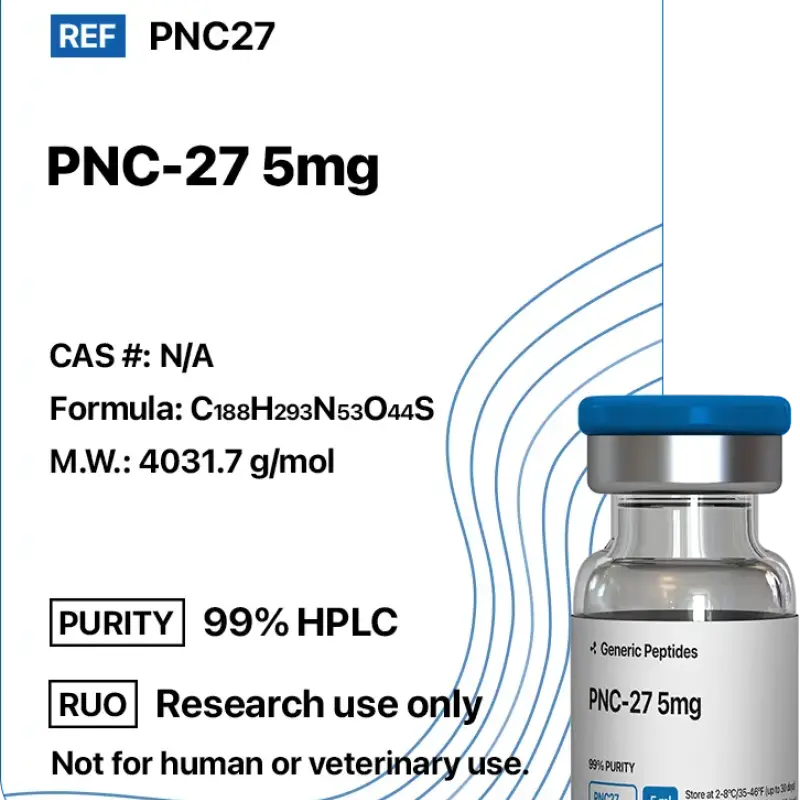
Generic Peptides PNC-27 is a 32 residue chimeric research peptide that joins a p53 fragment to a membrane-penetrating sequence, supplied as a 5 mg lyophilised vial.
Each vial is GMP-manufactured and HPLC-verified with a Certificate of Analysis on file, and reconstitutes with bacteriostatic water. PNC-27 for sale with U.S. domestic and international shipping.
Generic Peptides PNC-27 is a 32 residue chimeric peptide assembled from two parts: the p53 domain that binds HDM-2 and a membrane-penetrating sequence. The design places a p53 fragment where it can reach HDM-2 at the cell surface, and the compound is supplied as a 5 mg lyophilised vial for cell culture work. All published data are preclinical, and no human trials of the peptide exist.
PNC-27 binds HDM-2 on the surface of cancer cells, and the resulting complex forms pores in the membrane, which lyses those cells while leaving normal cells intact in the same cultures. The related compound PNC-28 uses a different penetrating sequence and behaves similarly in the same assays. Because the mechanism depends on HDM-2 appearing at the membrane, selectivity is a laboratory observation rather than a clinical result, and everything reported so far comes from culture and animal work.
A 5 mg vial with 1 ml of bacteriostatic water gives 5 mg per ml, so 1 mg measures 0.2 ml on a U-100 syringe and 500 mcg measures 0.1 ml; with 2 ml the same vial gives 2.5 mg per ml. Add the water down the wall and do not shake it. Other research vials on this line, such as TB 500 and BPC 157, are handled the same way, although their mechanisms have nothing in common with the p53 route.
Batches are produced under GMP conditions and checked by independent HPLC, with the Certificate of Analysis held per batch. No half-life has been established and no controlled human studies have been run, so the peptide has no clinical record at all and no human safety profile can be quoted. It must stay in the laboratory, and the Thymosin Alpha-1 vial on this line is the closest thing to an immune-focused research product in the same shelf.
For laboratory research only. Consult a healthcare professional before use.
| Trade Name | PNC-27 |
| Generic Name | PNC-27 anticancer peptide, 32 residues |
| Manufacturer | Generic Peptides |
| Dosage | 5 mg per lyophilised vial |
| Package | 1 vial of powder for reconstitution |
| Drug Class | Research peptide, preclinical anticancer agent |
| Administration | Reconstitute with bacteriostatic water |
| Reference Half-Life | Not established; no human data |
| Shipping | International and U.S. domestic options |
Consult a healthcare professional before any cycle. Where a stack suppresses natural testosterone, PCT is required. Doses are common community protocols.
Before you ask
It is PNC-27, a synthetic chimeric peptide of 32 residues supplied as a 5 mg lyophilised research vial. The molecule joins the p53 domain 12-26, which binds HDM-2, to a membrane-penetrating sequence. The compound has no approved form anywhere, and all published work is preclinical, so it is a laboratory reagent rather than a medicine.
It binds HDM-2 on the surface of cancer cells, and the complex forms pores in the cell membrane, which lyses those cells while leaving normal cells intact in the same cultures. Selectivity in culture depends on HDM-2 appearing at the membrane. The related peptide PNC-28 uses a different penetrating sequence and behaves similarly in the same assays, which supports the mechanism rather than any clinical claim.
No half-life is established. There are no human pharmacokinetic data and no phase I to III trials, and the project fact base records no estimates from primary sources either. Any timing used in laboratory work therefore comes from the design of the experiment rather than from a measured profile, and it should be treated as unknown.
With 1 ml of bacteriostatic water the 5 mg vial gives 5 mg per ml, so 1 mg measures 0.2 ml on a U-100 syringe and 500 mcg measures 0.1 ml. Two millilitres give 2.5 mg per ml, which suits smaller drawn volumes. Add the solvent down the vial wall, do not shake, and store the solution at 2-8 C without freezing.
Nothing at human level, because the peptide has never been tested in controlled human studies. Cell culture work describes selective lysis of cancer cells, and no clinical safety data exist to quote. That absence is the important fact: there is no established human safety profile, no known interactions and no long-term information.
Yes. The 5 mg vial is listed on this page with international and U.S. domestic shipping options, and the price charged matches the option you select. Orders are dispatched after payment confirmation. The product is sold strictly for laboratory research and is not a licensed medicine anywhere, so it may not be presented as a treatment.
Be the first to share your experience with Generic Peptides PNC-27 5 mg Anticancer Research Peptide Vial
Log in to write a reviewComplete the cycle
Out of stock
Out of stock
Out of stock