Generic Peptides
Generic Peptides NAD+ 100 to 750 mg Lyophilized Vials for Sale
No reviews yet
$45.00
Out of stock
Injection · 50 mg · vial
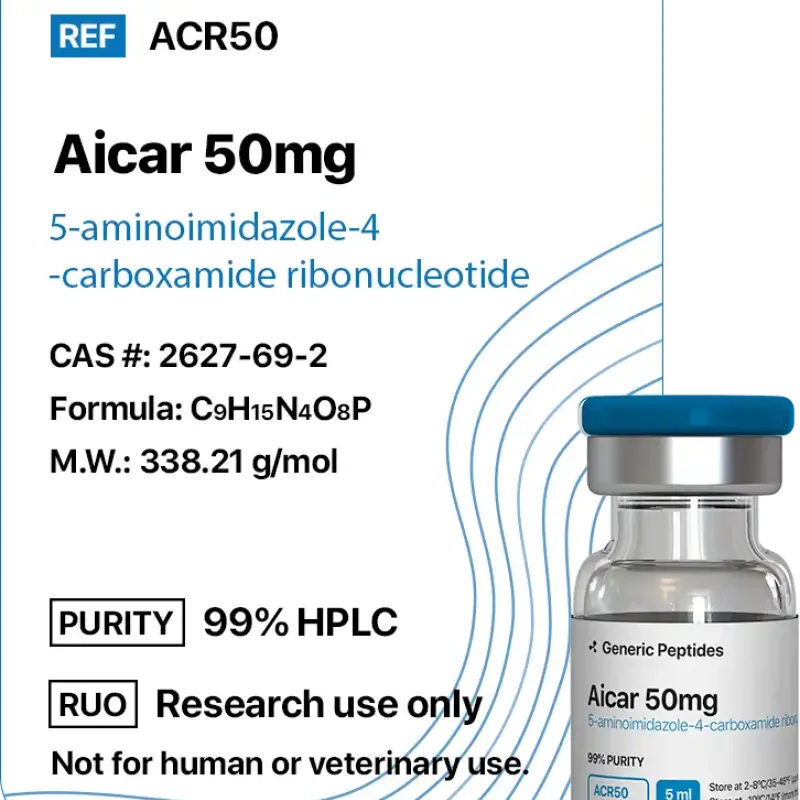
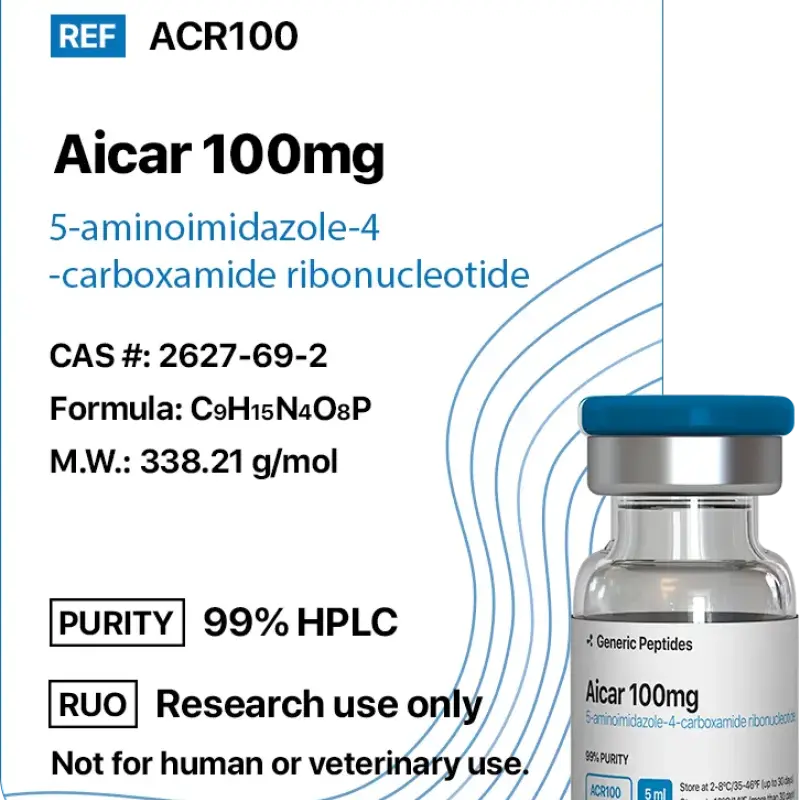
Generic Peptides AICAR is acadesine, an AMPK activator from the nucleoside family supplied as a lyophilized research powder in two vial sizes: 50 mg and 100 mg.
GMP-manufactured, each batch is HPLC-verified with the Certificate of Analysis on file. AICAR for sale with fast international shipping and dispatch within two business days after payment.
Generic Peptides AICAR is acadesine, an AMPK activator sold as a lyophilized research powder in 50 mg and 100 mg vials. It sits in this line because of the metabolic work it is used in, but chemically it is a nucleoside analog and not a peptide: its formula is C9H14N4O5 and its mass is about 258 g/mol. It is normally read next to another small metabolic molecule such as NAD+.
Both vials hold the same compound, so the choice is how much material one series needs.
| Variant | Dosage | Form and quantity | Best use |
|---|---|---|---|
| AICAR 50 mg | 50 mg | Lyophilized vial | Short runs |
| AICAR 100 mg | 100 mg | Lyophilized vial | Extended series |
The 100 mg vial carries twice the material of the 50 mg vial, and both are international only, with no U.S. domestic option on this page. A lipolysis fragment such as AOD 9604 is a common companion arm when fat metabolism is the read-out, while a glucose handling agent such as Semaglutide is kept in a separate group.
Cells take the compound up and convert it into ZMP, which mimics the effect of AMP and activates AMP-activated protein kinase. In skeletal muscle models that switch stimulates glucose uptake and p38 MAPK activity, and rodent work reports better endurance that appears to come from a shift of fast fibres towards an oxidative type; there is no human fibre type data. Human plasma half-life is about one hour. It is not approved, and the human cardiac programme stopped at the end of 2010.
The powder is dissolved with sterile or bacteriostatic water, which is not in the pack, added down the vial wall and swirled rather than shaken. Divide the amount on the label by the millilitres added: 50 mg in 5 mL gives 10 mg per mL. Keep the lyophilized vial at 2-8 C, protected from light, and the mixed solution at 2-8 C for about four weeks.
No human dose is stated here and the vial is not a medicine. AICAR has no approved indication and no validated human dose, so nothing on this page is a dosing guide. Scientific work on this compound has been reported in body weight terms rather than in a fixed milligram dose. Activators of AMPK are named in WADA class S4 and are banned in sport at all times.
Supplied for laboratory research only, not for human or veterinary use. Information provided is for educational purposes only and does not constitute medical advice. Consult a qualified healthcare professional before use. AICAR is supplied as a lyophilized powder and stays stable when the vial is kept cold and dry.
| Trade Name | AICAR |
| Generic Name | Acadesine (AICA-riboside) |
| Manufacturer | Generic Peptides |
| Dosage | 50 mg or 100 mg per vial |
| Package | Lyophilized powder, one vial |
| Drug Class | Nucleoside analog; AMPK activator |
| Administration | Subcutaneous (research protocols) |
| Storage | Lyophilized 2-8 C; mixed 2-8 C, 4 weeks |
| Prescription Status | Research use only |
| Verification | Batch details confirmed with supplier |
| Shipping | International, about USD 35; no USA option |
For laboratory research only. Consult a healthcare professional before handling any compound. Amounts shown are research references, not recommended human doses.
Before you ask
AICAR is the short name of acadesine, also written AICA-riboside, a small molecule that activates AMP-activated protein kinase. Its formula is C9H14N4O5, its mass is about 258 g/mol, its CAS number is 2627-69-2 and its ATC code is C01EB13. It was studied as a cardioprotective agent and in acute lymphoblastic leukaemia, and the human cardiac programme was stopped at the end of 2010.
No. AICAR is a nucleoside analog, which means it is built from a sugar and a heterocyclic base rather than from a chain of amino acids. It is sold in the same catalogue as research peptides because of the metabolic work it is used in, and its page sits in this line, but the compound itself has no peptide bond. That difference matters when a laboratory protocol is planned.
The compound enters the cell and is converted into ZMP, a nucleotide that mimics the effect of AMP on AMP-activated protein kinase and switches the enzyme on without any change in cellular energy charge. Downstream, skeletal muscle models show increased glucose uptake and p38 MAPK activity, and rodent studies report better endurance that seems to follow a shift of fast fibres towards an oxidative type.
Sterile or bacteriostatic water is added down the wall of the vial and the contents are swirled, not shaken; the solvent is not in the pack. Concentration is the amount on the label divided by the millilitres added, so 50 mg in 5 mL gives 10 mg per mL. The lyophilized vial is kept at 2-8 C, protected from light, and the mixed solution at 2-8 C for about four weeks.
No validated human safety profile exists for AICAR, because the cardiac programme was halted and no approved product followed. Reported items in the clinical literature include effects on glucose metabolism, which are expected of an AMPK activator, and bradycardia with haemodynamic changes in the cardiac setting. Injection site reactions are the common local effect in the injection class. Long term effects are not characterised, and the human dose is not established.
Yes. Activators of AMP-activated protein kinase are named in class S4, hormone and metabolic modulators, of the WADA Prohibited List, and acadesine has been on that list since 2009. Substances in that class are prohibited at all times, in and out of competition. In 2009 the BMJ reported traces of the compound in the blood of cyclists at the Tour de France, which is part of why the class was written.
Yes, both vial sizes are in stock on this page and can be ordered directly. The 50 mg and 100 mg vials ship internationally and there is no U.S. domestic option for this product. International shipping is about USD 35, orders are processed in one to two business days and transit runs four to ten days depending on the destination country.
Be the first to share your experience with Generic Peptides AICAR 50 mg and 100 mg Research Grade Vials
Log in to write a reviewComplete the cycle
Out of stock
Out of stock
Out of stock